
Annual Report 2025
(Excerpt: the full report can be requested from Epona Foundation for Horses and the Environment c/o Mermagen, Kesselstr. 15, 53797 Lohmar)

By the end of 2025, only two horses and one pony remained from the original Epona family: Kosmos, with whom everything began in 2009, Tobby, who came to us with Cookie from Normandy, and the Barb mare Aloha from Morocco. Kosmos is now 28 years old. He is fit and feels comfortable in “his” place in St. Joan in Sora. Others come and go, and sometimes one arrives who can become a friend. But not too close, because you never know when they will leave again…
Cookie left and Aranza arrived
Cookie left us in 2025. He died on April 3rd. For two days and two nights he had fought against colic, only to pass away peacefully in the end. Back then (see Annual Report 2012) we had taken him in together with Tobby after their owner had returned to England and simply left the two of them behind in the meadow in Normandy. Cookie loved being alone. He often wandered away from the herd through the woods and chose special spots for himself. A cave on the other side of the stream was one of his favorite places. And when it was time to change pastures and everyone crowded together, Cookie was nowhere to be seen. Much later he would stand alone at the fence, looking as if he were asking: And me?


Although Cookie and Tobby were so different—Tobby always right in the middle, and the bigger the herd the better, and even better with more mares—they were clearly connected by friendship. We only truly noticed this after Cookie’s death. Tobby suddenly stood apart, sad and alone. Even Julio couldn’t cheer him up at first. Later he could, once Tobby realized that he had to accept the inevitable, because Cookie would never return.
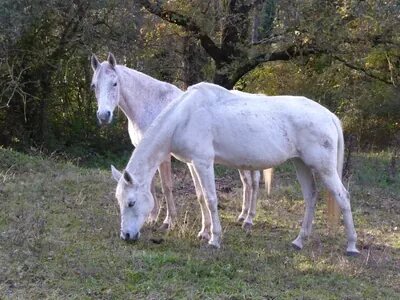
Aranza has newly joined us (her name means “hawthorn” in German), a gentle and well-balanced Arabian mare. She was born on February 10th, 2010, in the home of our hoof care specialist Xesco, on the same day as his daughter Oria. The two grew up together, and Oria learned to ride with Aranza. Of course, they also tried to see whether Aranza would be suitable as an endurance racehorse. But after three races it was clear: Aranza is not a racehorse. Instead, she clearly loved dressage. Her delicate, flexible body adapts perfectly to dressage movements. And because she is so gentle, she was constantly lent out to friends and family. Especially beginners quickly gained trust in this “sooo kind” horse, who accepted almost everything with great calmness and patience. Even though we told her that she could stay here with the Epona family forever, she didn’t believe it at first. Whenever a change was imminent, you could see that she was preparing for separation. At first, she also kept a bit of distance from the others, as if she feared being separated from a friend again. But now she has settled in and often doesn’t even lift her head when we enter the pasture. A warm welcome, Aranza, to your final home.


Aranza feels especially drawn to Sarah. Sarah, a typical riding stable horse, always kept separately from the others in a stall and small paddock where water and food are quickly accessible within a few meters, had a hard time integrating into the herd here and walking the sometimes long distances to the water. Several times we had to bring her up to the house because we feared she wasn’t drinking enough. Most of the time it was Aranza who accompanied her so she wouldn’t be alone.
Mercè: Dreams come true
Mercè Oms Molist, who has been taking care of the Epona horses every day for over ten years, wrote down her impressions of the year 2025: “For almost my entire life, I have been and still am out in the fields and pastures with the horses. I have seen and experienced a lot, and yet there are always surprises: in 2025 there were quite a few. I think that is also one of the reasons why I enjoy being with and among the horses so much. It is never the same, and there is always something new to learn. Just when everything seemed calm and in harmony with the herd, Cookie suddenly died. What remains is a feeling of gratitude for his presence over all those years, for being so independent, almost antisocial at first, but then becoming more and more integrated into the herd, including us humans. When he died at an old age (we do not know his exact age, see also the Annual Report 2012), we remembered his life, what we had shared, life in nature, and his end, where the natural process was allowed to take its unhindered course. Everyone experienced their grief over losing this strong-willed pony in their own way, especially Tobby. But the days pass, life goes on, and the herd and we adapt to the new reality. Everything returns to its course—until the next surprise.”

For me, 2025 was a year in which a dream that is 28 years old became real and took shape. When I was 19, I was at a stud farm in France. There was a project there with young women and men who had very different problems. They learned to understand and care for horses. I was able to observe how the horses, through their behavior, their love, and their sincerity, changed the lives of these people. That deeply impressed me, and I thought: one day I would like to realize such a project, where through and with the horses, through our love for them and above all their love, someone is enabled to see life differently. I am excited and curious, because now this project is being realized with the help of the Epona Foundation. There are years that remain more memorable than others—2025 was such a year, reminding us that nothing lasts forever, everything is constantly changing, and we should do what we can to make our dreams come true.”
Ramón: A good year for the birds
Ramón Baucells has been taking care of the Finca Terradelles de Dalt, the home of the Epona horses, for years. Ramón, a passionate nature lover and ornithologist, sums up what was especially important to him in 2025: “2025 was a good year for the finca. The seasons were clearly distinct from one another, although we had no extreme frost in winter and no particular drought or heat in summer. Spring was very beautiful, with good rain and mild temperatures. The greenery in the pastures was enough to provide the horses with feed well into the winter. The fauna and flora of the finca were also able to benefit from this good year in order to recover after two years of extreme drought. It was above all a good year for the birds. The nest boxes that we had hung everywhere were used by great tits (Parus major), blue tits (Cyanistes caeruleus), and—for the first time—by a pair of marsh tits (Poecile palustris). That was a surprise, because it is a rare species that actually lives near water and in wetlands. Breeding was successful, because young birds fledged from all the nest boxes.

The short-toed treecreeper (Certhia brachydactyla), the rock sparrow (Petronia petronia), and the black redstart (Phoenicurus ochruros) also nested in the natural stone walls of the masia from 1807. On the roof, between the old shingles, the white wagtail (Motacilla alba), the common starling (Sturnus vulgaris), the house sparrow (Passer domesticus), and the hoopoe (Upupa epops) built their nests. It gave us particular pleasure to see that, at the edges of the pastures in the hedges near the house, a pair of red-backed shrikes laid their eggs. They showed us how right it is to stack dead wood along the pasture edges so that small animals can find shelter there. There, too, pairs of Eurasian blackcaps (Sylvia atricapilla), nightingales (Luscinia megarhynchos), European greenfinches (Chloris chloris), and many other species cared for their young. Full of joy, we watched a group of yellow wagtails (Motacilla flava) stop here on their way to the warm south in order to strengthen themselves for the onward journey with insects among the horses’ legs. The black woodpecker (Dryocopus martius), the Iberian green woodpecker (Picus sharpei), the great spotted woodpecker (Dendrocopos major), the lesser spotted woodpecker (Dendrocopos minor), and the Eurasian wryneck (Jynx torquilla) enjoy the insect life in the dead branches of the tall poplars on the bank of the small stream in the valley opposite the house and barn, where the horses especially seek coolness in the hot summer. Every day, to our great joy and as confirmation of our work for nature, we see more birds in Terradelles de Dalt.
Besides the horses, a few other mammals are also at home here: a group of red deer (Cervus elaphus), many roe deer (Capreolus capreolus), and wild boars (Sus scrofa), which thoroughly enjoy wallowing in the mud of the small water springs above the house in the forest.


The plant world on the finca has also become increasingly diverse over the years. In 2025, we discovered two species for the first time that are interesting and not very widespread: the common cotoneaster (Cotoneaster integerrimus) and the autumn lady’s-tresses orchid (Spiranthes spiralis). Every year, more of the Scots pines die here in the Pre-Pyrenees, where until now they have mainly formed the forests. The causes are drought and the pine processionary moth (Thaumetopoea pityocampa), which has been able to multiply strongly because of the increasingly mild winters. That is why we are focusing our attention on downy oak (Quercus humilis), holm oak (Quercus ilex), common ash (Fraxinus excelsior), and Italian maple (Acer opalus), so that they can slowly replace the pine forest and thus create a woodland that, with its diversity, is more resilient to climate change and provides the horses with protection from heat, cold, and rain.
With this environmental work, we also provide a habitat for animals that are typical of open agricultural land. They are the ones that have declined the most because of intensive farming and the corresponding cultivation of the soil. In this way, Terradelles de Dalt gains biodiversity every day, and also green fodder quality for the well-being of the horses, which are kept here in a species-appropriate way and thus also contribute to the quality of the finca, because they help to create and maintain open areas.”


Projeto Uerê
We received the following report from Projeto Uerê in Rio de Janeiro:
Things in the slum are as usual - poor, complicated and some days also very violent. Many days the schools and the local health posts were closed due to difficult conditions in the neighbourhood. Police actions are hard handed and the criminal gangs continue to fight for territory. The truce between the rival gangs is fragile. People do what they can to make a living, but prices for rent, food and beverages have gone up. The local public schools are understaffed and teachers are often demotivated and look for jobs out side of the slum. Who would blame them. Some local NGO's do their best to offer entertainment for the kids, job opportunities for teenagers and help with food baskets for families with no income.
Projeto Uerê is a beacon of stability in the slum and every year, mothers hope that they can matriculate their children in the project. The waiting list is long. With all the tragedies in the world and partly also the ignorance of politicans it is difficult to find sufficient funding and it is an every year battle. But Yvonne and the staff go on and do whatever they can to make a difference. Thanks to all the sponsors who are loyal and committed.
Yvonne wrote to us about education:
The end of February 2026 we completed the enrollment at Projeto Uerê. There was a huge line at our door, with mothers asking for a place for their children. During the interviews, 80% of the children showed cognitive delays — in other words, they had not learned at the appropriate age. A tragic panorama of education. A country that does not educate its people chooses to remain small — not in territory, but in thought. Without solid instruction, language becomes impoverished, reasoning grows fragile, and public debate is reduced to slogans. As Paulo Freire reminded us, teaching is an act of emancipation; without it, dependence multiplies. And when critical thinking weakens, space opens for the kind of superficiality that Hannah Arendt so deeply feared: the trivialization of ideas and responsibilities. Education is not a social or political ornament; it is moral and cognitive infrastructure. Where it fails, innovation stagnates, citizenship weakens, and mediocrity ceases to be the exception and become the rule. To educate is to build the future, to neglect is to condemn generations to the repetition of the same backwardness. Brazil is still on this path…
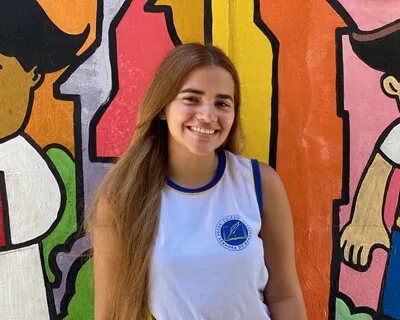
The Epona-Foundatioin supports Larissa`s education and her family. The family consists of the mother, maternal grandmother, and uncles, living in limited socioeconomic conditions, totaling five people in the household. The family has strong emotional ties and maintains a close relationship with the Projeto Uerê. The monthly income of the family group is estimated at 1 minimum wage, coming from informal work and social benefits. The per capita income is approximately R$ 1,700 (EUR 275/month). The apartment is rented, so there is not much funds left at the end of the month. The family is classified as being in a situation of socioeconomic vulnerability with partial stability, according to an analysis of the conditions presented. Larissa is a brilliant student and successfully completed the primary education. In 2026 she will enter the three years of secondary education. She is very focused and knows that she receives a unique chance to one day escape the fragile living conditions. Thank you very very much for supporting this wonderful young girl all those years.